Aid 5e - D&D 5th Edition Spell Book

Aid 5e DnD Spell
Aid 5e Image

Aid 5e Spell Effects

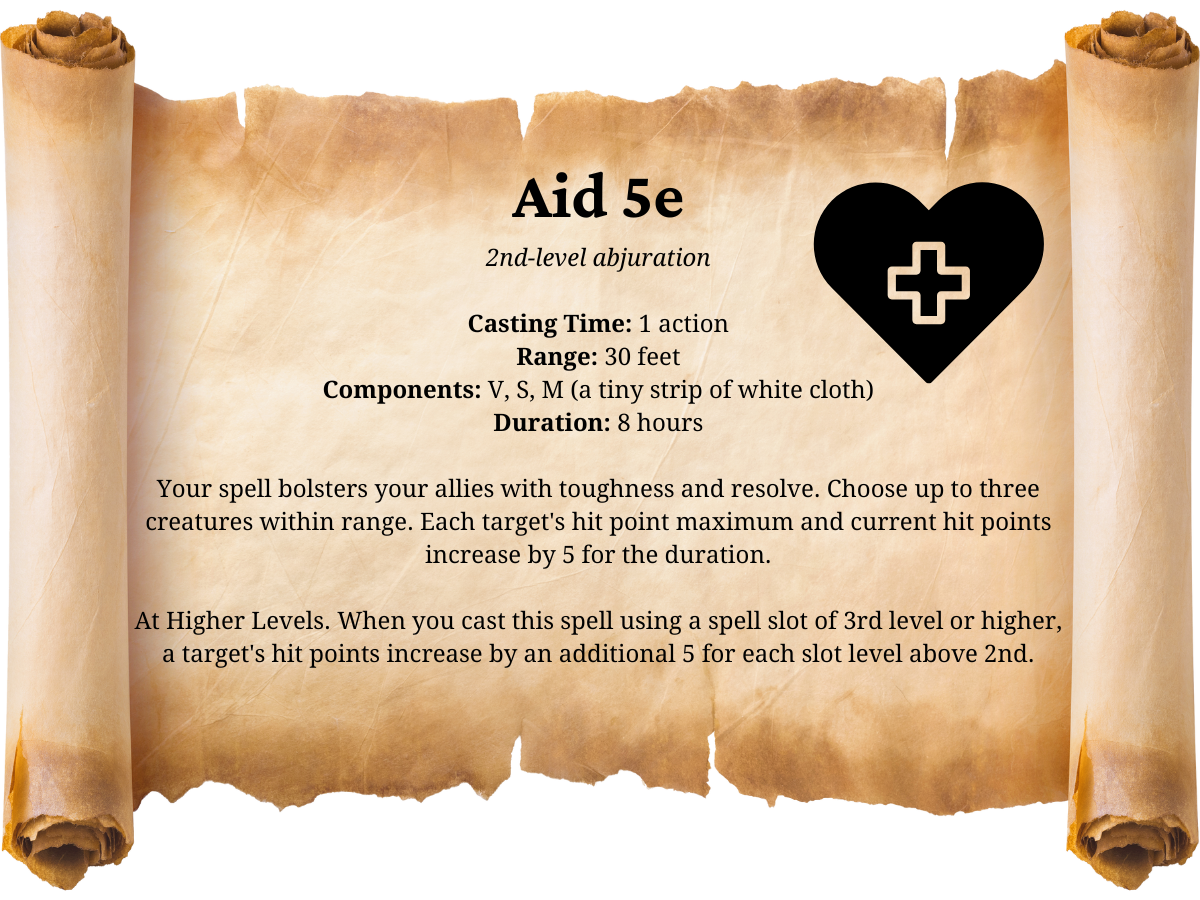
2nd-level abjuration


Casting Time: 1 action

Range: 30 feet

Components: V, S, M (a tiny strip of white cloth)

Duration: 8 hours


Your spell bolsters your allies with toughness and resolve. Choose up to three creatures within range. Each target's hit point maximum and current hit points increase by 5 for the duration.


At Higher Levels. When you cast this spell using a spell slot of 3rd level or higher, a target's hit points increase by an additional 5 for each slot level above 2nd.


All information about Aid 5e comes from the DnD Player's Handbook.
Aid 5e

Classes That Can Cast Aid 5e

The following classes gain access to casting Acid Splash 5e as part of their normal class spell availability:


Aid Spell Effectiveness

Temporary Healing 2nd Level Spell 3rd Level Spell 4th Level Spell 5th Level Spell 6th Level Spell 7th Level Spell 8th Level Spell 9th Level Spell
Healing Per Target 5 10 15 20 25 30 35 40
Total Healing Value 15 30 45 60 75 90 105 120

Healing Value

Note that since Aid 5e benefits up to three targets in spell range, the total healing/ temporary hit points provided can be significant. If the spell is cast upon a single target, it may not be very useful. However, for an adventuring party, Aid's effect can be dramatic, especially at higher spell levels.


Aid Usefulness

Aid 5e is an area of effect healing/ temporary hit point spell. Players should use Aid in the following circumstances:

  • When there are at least 3 allies in spell range who can benefit from its effects, to maximize the healing/ hit point value.
  • Preferably, before battle begins. Since the spell lasts for 8 hours, it can be cast at the start of an adventuring day. Then actions can be used during combat on other high-priority spells.
  • Against enemies who deal high amounts of damage. Being able to heal is a reactive approach to combat, whereas Aid 5e proactively increases hit points in anticipation of difficult battles.


Combine Aid 5e with the Following Spells

If you're trying to optimize your character, it's worth taking time to learn other spells, feats, and effects in D&D 5e that can turn the odds in your favor. Try combining Aid 5e with some of the following effects.

  • Bless 5e: in addition to other spell effects, bless gives targets a +1d4 bonus to saving throws. The extra chances of avoiding damage and debilitating effects are very valuable to a target who already has additional hit points.
  • Cure Wounds 5e: extra hit points have value whether you gain them before a battle, or during. Cure wounds is an excellent way to keep allies alive, and can be intimidating to face when the target is already benefitting from aid. 
  • Haste 5e: targets with haste have double movement speed, +2AC, and advantage on their Dexterity saving throws. A target with haste not only becomes harder to hit, but they're also able to easily run away from danger. Combined with the additional hit points from Aid, they become quite difficult to defeat.
  • Mage Armor 5e: similar to haste, mage armor provides additional AC for the target, bringing their base AC up from 10 to 13.


Aid 5e Counters

Since Aid 5e can be cast before battle even begins, there aren't exactly hardcore "counters" specifically against the spell (such as Silence 5e, which is normally a bane to all spell casters). However, in general, since the extra hit points from aid 5e are spread out to three targets, you may want to be cautious of fighting enemies with area of effect attacks, such as Acid Splash 5e.


Aid-Type Spells in Eternity TTRPG

Eternity TTRPG also has its own indie TTRPG by the same name: the Eternity TTRPG Game System. The game allows for multiple game masters, and provides a way even for game masters to still roleplay characters of their own during your RPG campaign.


Though Eternity TTRPG is entirely its own separate RPG system from D&D 5e, there are some similarities. Check out how a spell similar to aid 5e works in Eternity TTRPG, below.
Summoner Class Icon

Summoner - Core Class Spell

Aeon (Magic): this Spell requires 2turns to cast, which do not need to be consecutive. You may “prepare” the first 1turn of this Spell even when no targets are in Range, then finish casting at any later time during the same Battle that you’d like. You can only have one (1) summoner Spell “prepared” at any given time.

Up to 3 allies in 4Range, heal +1HP. This

Spell allows affected targets to heal 1HP above their normal max HP. This effect also Fatigues affected targets, giving -1Resilience, -1Dodge, and -1Will for 1Day Duration (can stack without limit).

  • (Summoning) 10Range. You also have 10Range when casting this Spell, for Battle Duration.
  • (Mystic Infusion) +2HP. This effect also Fatigues affected targets, giving -2Resilience, -2Dodge, and -2Will for 1Day Duration (can stack without limit).
  • (Enhanced Gateways) You also have +7Initiative while casting this Spell (for 2turns).


All healing spells in Eternity TTRPG allow characters to "over-heal" their targets, by at least 1HP. So, in that sense, all healing spells in Eternity TTRPG are similar to aid 5e. However, Aeon from the summoner class is one of the only spells in the game that allows for area of effect, or multi-target healing. With a Critical, Aeon can provide substantial healing value, reach much further than normal, or also increase the caster's initiative value for a short time.


Curious to learn more? Check out the Eternity TTRPG Core Game PDF!

Summoner - Core Class Spell

Aeon (Magic): this Spell requires 2turns to cast, which do not need to be consecutive. You may “prepare” the first 1turn of this Spell even when no targets are in Range, then finish casting at any later time during the same Battle that you’d like. You can only have one (1) summoner Spell “prepared” at any given time.

Up to 3 allies in 4Range, heal +1HP. This Spell allows affected targets to heal 1HP above their

normal max HP. This effect also Fatigues affected targets, giving -1Resilience, -1Dodge, and -1Will for 1Day Duration (can stack without limit).

  • (Summoning) 10Range. You also have 10Range when casting this Spell, for Battle Duration.
  • (Mystic Infusion) +2HP. This effect also Fatigues affected targets, giving -2Resilience, -2Dodge, and -2Will for 1Day Duration (can stack without limit).
  • (Enhanced Gateways) You also have +7Initiative while casting this Spell (for 2turns).


All healing spells in Eternity TTRPG allow characters to "over-heal" their targets, by at least 1HP. So, in that sense, all healing spells in Eternity TTRPG are similar to aid 5e. However, Aeon from the summoner class is one of the only spells in the game that allows for area of effect, or multi-target healing. With a Critical, Aeon can provide substantial healing value, reach much further than normal, or also increase the caster's initiative value for a short time.


Curious to learn more? Check out the Eternity TTRPG Core Game PDF!

Summoner - Core Class Spell

Aeon (Magic): this Spell requires 2turns to cast, which do not need to be consecutive. You may “prepare” the first 1turn of this Spell even when no targets are in Range, then finish casting at any later time during the same Battle that you’d like. You can only have one (1) summoner Spell “prepared” at any given time.

Up to 3 allies in 4Range, heal +1HP. This Spell allows affected targets to heal 1HP above their normal max HP. This effect

also Fatigues affected targets, giving -1Resilience, -1Dodge, and -1Will for 1Day Duration (can stack without limit).

  • (Summoning) 10Range. You also have 10Range when casting this Spell, for Battle Duration.
  • (Mystic Infusion) +2HP. This effect also Fatigues affected targets, giving -2Resilience, -2Dodge, and -2Will for 1Day Duration (can stack without limit).
  • (Enhanced Gateways) You also have +7Initiative while casting this Spell (for 2turns).


All healing spells in Eternity TTRPG allow characters to "over-heal" their targets, by at least 1HP. So, in that sense, all healing spells in Eternity TTRPG are similar to aid 5e. However, Aeon from the summoner class is one of the only spells in the game that allows for area of effect, or multi-target healing. With a Critical, Aeon can provide substantial healing value, reach much further than normal, or also increase the caster's initiative value for a short time.


Curious to learn more? Check out the Eternity TTRPG Core Game PDF!

Share This Article

Jacob Tegtman Eternity TTRPG Creator

Author - Jacob Tegtman

Dear reader, I hope you enjoyed this article. Tabletop gaming has been a passion of mine since I was 6 years old. I've played just about every game from Dungeons and Dragons to video games like Final Fantasy. These games have inspired me, made me laugh, made me cry, and brought me endless hours of enjoyment.


I started Eternity TTRPG - and the indie tabletop game that goes along with it (Eternity Shop) - to share my love of gaming with others. I believe that in our technology-driven age, tabletop games help bring a sense of magic and community back into our world.


If you love the site, please share it with others! I have lots of gaming-related material for you to peruse and use in your own gaming sessions. If you have any questions about the site or want to contribute, just send me a message using the "Contact" page, which you can find in the site's footer.

By Jacob Tegtman November 25, 2025
Transcribed content from our recent YouTube video: https://www.youtube.com/watch?v=JgWieYGo8k8 Transcription In Druskenvald, the fields whisper. When the harvest is ready, something else rises too — figures of burlap and bone, lit from within by ancient green magic. Welcome to Druskenvald, under the eerie light of the Crooked Moon, where the Harvestborn stand as living scarecrows bound to the land, the harvest … life and death. Crooked Moon has become one of my favorite adventure supplements of all time, and you can get a copy from D&D Beyond. Today on Eternity TTRPG , we’re diving deep into one of the most unique ancestries in the Crooked Moon setting: the Harvestborn . Whether you’re a player looking to build an unforgettable character, you’re a DM planning your next atmospheric campaign, or just someone who loves rich D&D lore, this video is for you. We’re breaking down who the Harvestborn are, where they come from, what makes them so magically eerie, and how their mechanics and lore work together to create incredible storytelling opportunities. Think of this as your complete guide to understanding — and playing — these scarecrow-souled guardians of Enoch.” The Harvestborn are somewhat like other mechanical races in D&D — but their spooky scarecrow model just makes for great stories, worth telling. In The Crooked Moon / Druskenvald setting, each ancestry (or “species”) does have a sort of “home province,” but that doesn’t necessarily mean they only exist there. Harvestborn are a constructed species native to the province of Enoch in Druskenvald. According to lore, they are crafted with great care by the lord of Enoch, Methuselah. These constructs are infused with a vibrant, green magic — the same life-essence that flows through the fertile fields of their homeland. Methuselah is the patient, almost paternal figure who oversees the province of Enoch . He is deeply attuned to the green magic of his land — not merely as a ruler, but as a guardian of the cycle of life, death, and rebirth: under his watch, Harvestborn are created, nurtured, and eventually laid to rest so they may be reborn. Though he is a lord, Methuselah is less interested in dominion through fear, and more through stewardship: his role is tied to growth and harvest, not conquest. This makes him a figure of both authority and nurture — one who shapes his people not just from straw and wood, but with intention and magic. In a province-overview document for Enoch, Methuselah is described as: “a black-furred cat-man with eyes as gold as the province’s grain fields …” For role-playing, you could lean into the mystery of who this creator of Harvestborn is, and how his Character affects the Harvestborn: Where did this mysterious, and obviously powerful figure come from? What is his magical or ancestral origin? Does he share any soul-link with his Harvestborn creations? Back to the Harvestborn, they resemble scarecrows — bodies of wood, straw, metal, and other implements. Their heads glow, sometimes made from pumpkins, turnips, or even burlap sacks. But though they look like eerie husks, they are deeply tied to life … and to death. In their society, they live in harmony, focusing on community, fellowship, and the cycles of growth. Food is their harvest; death is their rebirth. Mechanically, Harvestborn are constructs — not quite living, but driven by magic. They are Medium size, approximately 4 to 7 feet tall, and in-game move at 30 feet per round. One of their defining traits is called Culling : when a Harvestborn damages a creature that is already wounded, they can deal an extra 1d12 necrotic damage . That’s powerful — especially when you’re finishing off a foe.” But like their creator, they’re not just about dealing death. Harvestborn also have Gift of the Green . As a bonus action, you can touch the ground and grant healing: a friendly creature within 30 feet can roll a Hit Die, and they heal the amount rolled plus your proficiency bonus. Then there’s Jack-O-Lantern : you know the Dancing Lights cantrip, and you choose whether your spellcasting ability is Intelligence, Wisdom, or Charisma. Being constructs, you don’t need to breathe, eat, or drink. That’s the Scarecrow Nature trait. And for rest, you can actually skip sleep entirely: instead, you can take a Watchful Rest — staying motionless and conscious for 4 hours, but still count it as a long rest. The Harvestborn are deeply thematic. Their existence is a living tension between life and death — they harvest crops, but they also harvest life’s vital essence. Their cycle of rebirth is intrinsic: they often live around 100 years , and then ‘accept death’ … only to be reborn again. As a player, this opens up incredible role-playing opportunities. Do Harvestborn remember their past incarnations? Do they cherish each lifetime, or dread what comes next? Are they fully aware of their created nature … or do they feel things in a way similar to how a living soul does? From a thematic standpoint, Harvestborn embody folk horror beautifully: agricultural rituals, seasonal death and rebirth, quiet sacrifices in the fields. Their identity is bound to community — they grow and heal their people, they protect the land … but they are also constructs, perhaps seen as eerie or uncanny by outsiders. On a personal level: what memories do Harvestborn carry between lifetimes? Do they still form strong bonds with people of other ancestries, knowing they might reincarnate only to find their friend permanently dead? And then, perhaps, do they fear what it means to be reborn? “So — why pick a Harvestborn for your Crooked Moon game? First, for the unique flavor: you’re not a typical D&D race. You’re a magical construct with deep roots in folk horror. Your mechanics reflect a duality: offensive power (Culling) and support (Gift of the Green), with cycles of death and rebirth.” “Second, the role-playing potential is huge. Harvestborn come built in with internal conflict, an apparently never-ending cycle of life and death, the mystery of reincarnation — that’s rich ground for character development. And third, they fit the Fall/ Harvest time aesthetic: moody fields, harvest rituals, green magic shimmering in twilight — Harvestborn are made for a Harvest/ Halloween setting.” At the end of the day, Harvestborn are more than just scarecrows — they are echoes of the land itself, vessels of green magic, and agents of an eternal cycle. In the folk-horror world of The Crooked Moon, they also bring a unique combination of power, mystery, and heart.” But now, it’s your turn. If you were to play a Harvestborn in your next game, how do you think you’d face your life, knowing that even after death – you’d simply be reborn? Would you welcome rebirth — or resist it, knowing that you’d never be able to outrun yourself, even at the end of your life? And if you could carry something forward into your next life – experiences you’ve had, love you’ve shared, desires you’ve felt, what would that be?” “Drop your thoughts in the comments — I’d love to hear your cool Harvestborn roleplay ideas. And if you enjoyed this deep dive into one of Crooked Moon’s coolest ancestries, don’t forget to like, subscribe, and hit the bell. Next time, we’ll explore another one of Crooked Moon’s lineages. Until then, may your roots stay deep, your light burn bright, and may every ending lead you toward your next beginning.
Critical Role episode 3 summary graphic. Four fantasy characters stand before a golden logo.
By Jacob Tegtman November 22, 2025
Transcribed content from our recent YouTube video: https://www.youtube.com/watch?v=ZRQRNqRGVMs Transcription Hey everyone, welcome back to Eternity TTRPG.  With the last recap of Critical Role’s fourth campaign, in episode 2, the Falconer’s Rebellion echoed through Dol-Makjar, and an angel’s bloodline rewrote what faith looks like in the series. This third episode — The Snipping of Shears — pulls those threads tight: divine secrets, infernal bargains, and a murder that changes everything. As a quick note before jumping in, if you haven’t seen my prior recaps of this Critical Role campaign, you should know that A LOT happens in these 4.5hr-ish episodes. Cutting all of that down to about 10minutes means that there will be a lot of summarization. If there’s anything you don’t quite follow, check out my previous recaps for more context. This episode opens with Teor Pridesire, the soldier trying to live quietly under the banner of the Candescent Creed. Sir Filoneus Halovar hires him as Wick Halovar’s new bodyguard and sends him to the Mercanaud Couturier — a tailor’s shop with more whispers than fabric. In the bustling Ogrimok Market, where magic is forbidden, Teor runs into Sir Julien Davinos, who’s searching for Occtis Tachonis. Julien recognizes the Couturier’s name — they make problems disappear for the Halovars. Teor, unaware, walks straight toward them. Back in Villa Aurora, Wick faces a truth that upends everything he believes. Photarch Yanessa Halovar reveals that the chained celestial beneath their temple — Aetheon — is his grandfather. After the gods fell, she took Aetheon’s blood and wished for a child touched by the sun. That child became Godard, Wick’s father — and the foundation of the Candescent Creed. The Halovars turned divine theft into religion. Yanessa built her empire of light to survive a world without gods — and tells Wick the rules of faith are for others. His duty is legacy: marry well, expand Filament, and remember that true power runs in the family’s blood. For Wick, his prior belief has just curdled into this sickening feeling of betrayal. Reeling from the truth, Wick turns to the only person who’s ever been somewhat(?) fully honest with him — his demon companion, Tyranny. She was crafted by the Prince of Demonkind, to serve the Creed’s image, and bargain for souls. But Tyranny hates her purpose. She’s bound to Wick alone, and begs him not to send her back to the Pit. They realize they’re both trapped by family expectations — a believer and a demon chained by faith and fear. Wick promises she’ll stay free, and together they plan to rescue Teor before the Halovars decide that he’s expendable. In another corner of Dol-Makjar, the hunt for Occtis grows dangerous. At the Penteveral, Murray Mag’nesson stands up to Primus Tachonis himself — and is promptly cursed for it. Meanwhile, Occtis, Thimble, and Kattigan are ambushed by the Crow Keepers in the Guard Tower. Vaelus bursts in mid-fight, saving Thimble from a grisly end. The gang learns that Casimir — Thimble’s former ally — had been stealing from the Crow Keepers, paid his debt in blood, and left behind a deed to a fortress, now stolen by Cyd. It’s one more piece in a spreading puzzle of betrayal. While others fight and scheme, Thaisha and Hal Fang build something new — the Hallowed Round, a theatre rising from Dol-Makjar’s old scars. Once a temple of oppression, it’s now reclaimed for art and community. An orc musician reminds Thaisha that rebellion isn’t just war — it’s creation. At the Couturier, Teor meets the Mercanaud brothers — charming, unsettling, and reeking of infernal power. Before he can act, he’s trapped in a circle carved into the floor — a nine-pointed star that reeks of sulfur. Calastro Mercanaud begins cutting Teor’s shadow apart, piece by piece, with silver shears. Then, salvation: Wick and Tyranny arrive under false orders, bluff their way in, and free Teor. The three escape, but Tyranny’s terror says everything — they’ve just angered something far darker than House Halovar. At Hal’s home, the pieces finally align. Hal attunes to Thjazi’s sword — the Liar’s Blade — and sends Thimble north to avenge their brother. Wick, Tyranny, Teor, Thimble, and Kattigan form a small band: the Soldier’s Table. Azune watches them ride out, whispering the names of the fallen. It feels like history beginning again. At the Palazzo Davinos, the story turns from politics to nightmare. Julien watches in frozen horror as an invisible assassin reaches into his father’s skull and pulls it free. Upstairs, Occtis and Aranessa are trapped by silence as his brother Ethrand arrives — holding the Stone of Nightsong. He orders the ghouls to open Occtis’s chest and put the stone ‘where it belongs.’ And then? Fade to black. Alright — here’s why The Snipping of Shears hits so hard, and what you can learn from it for your own table.” 1. Secrets mean more when they’re personal. When Wick learns that his faith is built on a lie — that his family’s light was stolen from a fallen celestial — it’s devastating not just because it’s awesome lore, but because it’s his grandmother telling him the truth. That’s the lesson: don’t dump exposition from an old scroll. Deliver it through someone the character trusts. When revelations come from family, mentors, or companions, the heartbreak feels real, and the fallout drives roleplay for sessions to come. 2. Make corruption generational. The Halovars inherited sin. Yanessa’s wish twisted faith into an empire, Godard’s blood carries celestial power as a burden, and Wick now bears that legacy whether he wants it – or in this case, definitely not. And that’s the power of it. Tyranny’s existence also mirrors that cycle — a demon born into a contract she never chose. If you want emotional weight, make power in your world come with ancestry, or family, attached. Maybe a magic sword remembers every life it’s taken, or a player’s bloodline is blessed by something they don’t believe in. Legacy as corruption creates tension between destiny and free will — one of the best engines for storytelling in D&D. 3. Mix horror with heart. The Couturier scene in this episode works because of what’s being taken. Teor’s shadow — his literal sense of self — is being cut apart. It’s a nightmare. And it is the kind of horror that lingers. When using horror at your table, think beyond monsters. Ask, ‘What does this threaten about who the character is, at their core?’ A curse that erases memories, a haunting that whispers a player’s thoughts back to them — those are the scares that deepen character growth. And that’s it for Episode 3. Celestial secrets, infernal contracts, and one unforgettable assassination. What do you think — is Wick destined for redemption or ruin? Drop your theories below, and join me next time as we follow the Soldier’s Table north. Until then — let your dice fly, and may your stories be legendary.
Table display of D&D gifts and game inspiration; dice holders, artwork, and character cards.
By Jacob Tegtman November 22, 2025
Know someone who’s a D&D fan? Not sure what to get them for Christmas? Or are you a D&D player and want to treat yourself?
Show More