Dungeon A Day - Furiaes Castle - Day 29

In a leaf-fallen forest, under a full moon, a dark shadow lies over a single cottage. Looking up, you can just make out the outline of a ghost-like castle, somehow floating in the autumn skies.


Beneath it, candle-like wisps flit about, summoning all souls who can hear their call, to the "doorway" through which all may pass to the floating keep.


This is the place to which children from the nearby village have been kidnapped, reports claim. But seeing Furiaes Castle in person is more unsettling than you'd hoped.


Day 29 - Throne of the Ladies Furiaes


Use the Dungeon A Day Adaptation Page to Modify this Content to fit Your Favorite TTRPG
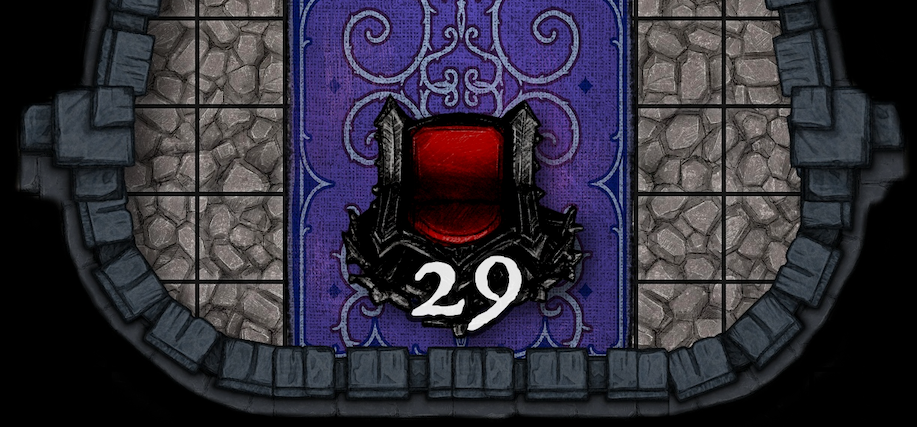
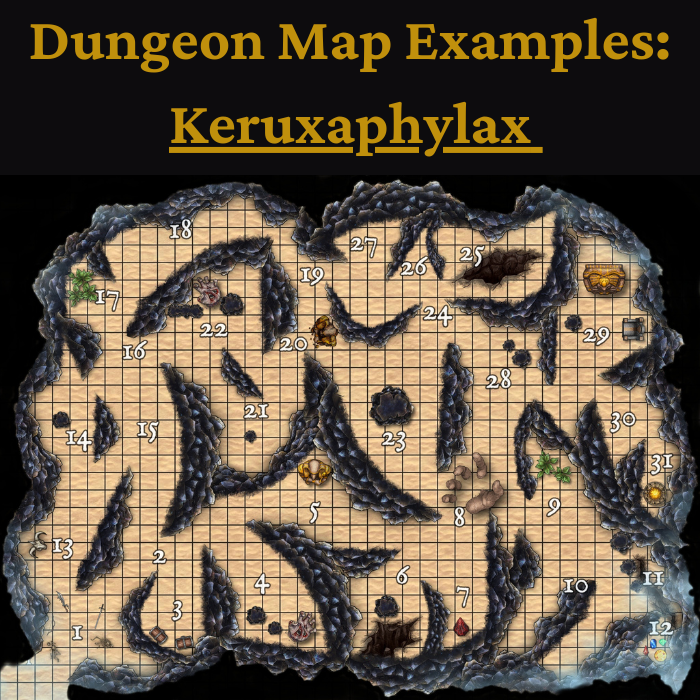
There is a red throne in the middle of a room with the number 29 on it.

Room Description (Read the Following Text to Your Players)

Piano music, grim and echoing, reaches your ears from some distant and hidden place in the castle. Upon the ornate, crimson throne of the Furiaes rests and purs a black cat, peering at you with glowing, orange eyes.


Shadows coalesce around each of your feet, shifting into uncomfortable and frightening shapes.


(If players chased away Lady Omega from dungeon room 6/7, and Lady Alpha from dungeon room 13/14, they are now present here, as guardians of the throne).


(If the party has yet to permanently dispatch of the porcelain doll first - in dungeon room 23, then the following also occurs).


Additionally, a shadow-black creature emerges from the ground beneath the porcelain doll, raising it into the air. There, it hangs, as if by marionette wires, cackling maniacally. 4-additional arms ending in razor sharp claws emerge from the creature's back as it advances towards you.


Room Challenges

  • Black Cat - The Furiaes, Tisiphone: characters entering this room roll Resilience (Fate Roll Difficulty matches Avg. Party Level). If they fail, they become afraid of the shadows coalescing around them, and no amount of coaxing or willpower of their own can cause them to leave the room, or even act at all. "Fear" may be removed with any dispel effect, or once the black cat is defeated. If all players are Feared, this adventure will end as all characters are killed, so you should probably fudge rolls if they're all getting caught in this effect. Otherwise, once these rolls are over, the black cat, Tisiphone, grows into a shadows "cat sith" and immediately attacks.
  • Second Furiaes: if the party slays the cat sith, it meows pathetically, then lies still. The cat sith then turns into the form of a human woman, covered in rich robes, eyes closed and lying in her own blood.
  • Porcelain Doll/ Monstrous Shadow: when the doll is defeated, the shadow disperses with a roar, and the doll is dropped to the ground. It lets out a deep sigh, and says, "...thank you..." then shatters into pieces, and this time, for good. After this dungeon room, the porcelain doll no longer follows the party.


Enemy Stats

Cat Sith, Tisiphone: "Demi Boss" enemy Difficulty (match Avg. Party Level, -4). Option to use the "Assassin AI." Each turn, Cat Sith summons a ghost to serve and defend it, as an Instant Action, which appears within 4Range. Each ghost is a "Weak" enemy difficulty (match Avg. Party Level, -4). Option to use the "Baseline AI." See the Dungeon A Day - Enemy Stats and AI page for more details.


(Lady Alpha): if present - "Common" enemy Difficulty (match Avg. Party Level). Option to use the "Baseline AI." See the Dungeon A Day - Enemy Stats and AI page for more details.


(Lady Omega): if present - "Weak" enemy Difficulty (match Avg. Party Level). Option to use the "Baseline AI." See the Dungeon A Day - Enemy Stats and AI page for more details.


(Porcelain Doll/ Monstrous Shadow): "Hero" enemy Difficulty (match Avg. Party Level, +2). Option to use the "Berserker AI." See the Dungeon A Day - Enemy Stats and AI page for more details.
Dungeon A Day Subscription Shop

Dungeon A Day

Visit the Dungeon A Day - Furiaes Castle Overview Page for all Dungeon Rooms in this series.


Visit the Dungeon A Day main Page to see all of the Eternity TTRPG dungeons!

Share This Article

Jacob Tegtman Eternity TTRPG Creator

Author - Jacob Tegtman

Dear reader, I hope you enjoyed this article. Tabletop gaming has been a passion of mine since I was 6 years old. I've played just about every game from Dungeons and Dragons to video games like Final Fantasy. These games have inspired me, made me laugh, made me cry, and brought me endless hours of enjoyment.


I started Eternity TTRPG - and the indie tabletop game that goes along with it (Eternity Shop) - to share my love of gaming with others. I believe that in our technology-driven age, tabletop games help bring a sense of magic and community back into our world.


If you love the site, please share it with others! I have lots of gaming-related material for you to peruse and use in your own gaming sessions. If you have any questions about the site or want to contribute, just send me a message using the "Contact" page, which you can find in the site's footer.

By Jacob Tegtman January 15, 2026
Transcribed content from our recent YouTube video: https://www.youtube.com/watch?v=QQLN8bvlo-Q Transcription If you’re like me, you just watched Stranger Things Season 5, and it was amazing. Personally, I felt like it really hit similarly to the first season – they did a great job. But you're watching Stranger Things, getting hyped about seeing D&D represented in mainstream media, when suddenly Mike declares he's casting a spell, as a paladin... at first level. And you're sitting there thinking, "Wait, that's not how that works." Well, you're not alone. Today we're diving deep into three quick, but glaring D&D mistakes – or, perhaps intentional and fun D&D alternations – that Stranger Things has made throughout its run. I love Stranger Things, so this is by no means a criticism of the show. If anything, some of these mistakes just makes me like it more. Because, let’s get real – most D&D games fudge something in the rules anyways. It’s part of the fun. And no one really wants to be a rules lawyer all the time. What's up, dice rollers! Welcome back to Eternity TTRPG where we explore everything that makes tabletop RPGs amazing. I'm your host, and today we're taking a critical but loving look at how Stranger Things – arguably the biggest mainstream representation of D&D we've ever had – got some pretty fundamental (and sometimes funny) things wrong about our favorite hobby. Now, before we dive in, let me be clear: I absolutely love that Stranger Things brought D&D into the spotlight. The show has introduced countless people to our hobby, and that's incredible. As D&D enthusiasts, we can appreciate the show while also having some fun pointing out where the Duffer Brothers maybe should have consulted their Player's Handbook a bit more carefully. So grab your dice, settle in, and let's explore three quick strange things that Stranger Things got wrong about D&D. Mistake #1: The Demogorgon Campaign Confusion I’m gonna call this “Mistake #1,” by the way, and you’ll find out why in just a minute. But let's start with this big one from Season 1. In the very first episode, we see the boys playing D&D, and Will's character encounters the Demogorgon. Now, the show treats this like it's some kind of final boss encounter, but here's the problem: a Demogorgon in D&D is a CR 26 creature. Basically, a Lv.26 monster. That's endgame content for level 20 characters. These kids are clearly playing low-level characters – probably somewhere between levels 1-5 based on their abilities and the campaign Mike’s describing. A real Demogorgon would obliterate their entire party in a single round without breaking a sweat. It would be like sending a group of mall security guards to fight Godzilla. What the show probably meant to use was a lesser demon or maybe just called it a "demogorgon" as a generic monster name. But for D&D players, it's like watching someone try to drive a car with a boat steering wheel – technically it's transportation equipment, but it's completely wrong for the situation. Is this really a mistake though? I’d say yes, technically. But also, we all know how kids get when playing games. Mike was probably like, “hey, you know what would be cool for my party of Lv.5 adventurers? Give them something that inspires them. Like this CR26 literal god.” It’s the type of move that every DM has done at some point – just go way, wayyy overboard. And again, that’s part of the fun with games like D&D. Mistake #2: The Paladin Spell Situation This one is really funny to me because it happens multiple times throughout the series. Mike's primarily the dungeon master for his group. But when he plays, his character is consistently referred to as a paladin, and we see him attempting to cast spells at what appears to be first level. Here's the issue: in every edition of D&D that would have been available when Stranger Things is set – we're talking late 70s to early 80s – paladins don't get spells until much higher levels. In AD&D (Advanced dungeons and dragons), paladins don't get their first spell until 9th level. Even in modern 5th Edition, paladins don't get spells until 2nd level. But the show has Mike casting spells right from the start. It's a small detail, but it shows a fundamental misunderstanding of how the class works. It would be like showing a wizard swinging a two-handed sword as their primary weapon – technically possible in some circumstances, but it misses the point of the class – for that level, at least – entirely. It’s another “mistake” though that many groups would make, probably especially kids. You want to play a character who can do cool things, at any level. So maybe this was another intentional move on the Duffer brothers’ part, showing not just the rules for D&D, but how people actually play. Mistake #3: The Dice Rolling Drama This one’s more about dramatic license. Throughout the series, we see characters making single dice rolls for incredibly complex situations, and the entire outcome hinges on that one roll. Real D&D involves a lot more dice rolling and a lot more back-and-forth between players and the DM. Combat isn't usually resolved with a single dramatic roll – it's a series of attack rolls, damage rolls, saving throws, and tactical decisions. The show makes it look like D&D is just "roll a d20 and see what happens," when the reality, as we all know, is much more nuanced. The most egregious example is in Season 1 when Will's fate seems to hinge entirely on a single d20 roll. While dramatic moments like this can happen in D&D, they're usually the culmination of a longer sequence of events, not the entire encounter. Of course, filming four kids rolling dozens of dice over and over doesn’t make for great visual episodes, I assume. This one is really more to point out that anyone who isn’t familiar with D&D may be a bit surprised walking into a real gaming session at how many dice really do get rolled. On platforms like Reddit, the D&D community's reaction to these inaccuracies has been... interesting. Players have been discussing these since the show premiered. One user pointed out in a popular thread: "I love that Stranger Things brought D&D to the mainstream, but I wish they'd gotten a consultant who actually understood the game mechanics. It's like they researched D&D by reading about it rather than playing it." Another user noted: "The show gets the emotional core of D&D right – the friendship, the collaborative storytelling, the escapism. But the mechanical details are so wrong that it's distracting for anyone who actually plays." Now, do these mistakes matter? I would argue they don't – Stranger Things is a TV show, not a D&D tutorial. People may come into the hobby with incorrect assumptions on how things work. But, if more people are getting into the hobby, then that's positive. And D&D – or let’s at least say tabletop roleplay games – have experienced unprecedented growth partly thanks to Stranger Things, and that's amazing for our community. So here's what I want to know from you: is there anything else fun or silly that I missed from Stranger Thing’s D&D inaccuracies? I’m sure there has to be more than just these three, so please hit me up in the comments and let me know what you’ve found! And that wraps up our dive into Stranger Things, for today. Remember, this comes from a place of love – both for the show and for D&D. If you enjoyed this quick video, make sure to hit that like button and subscribe for more D&D content. Whether you're fighting demogorgons in the Upside Down or just trying to survive your first dungeon crawl, keep those dice rolling!
Dragonlance
By Jacob Tegtman December 17, 2025
Transcribed content from our recent YouTube video: https://www.youtube.com/watch?v=257fKzW8yzA Transcription Before there was Game of Thrones, Baldur’s Gate, and Critical Role.… there was Dragonlance .  A fantasy saga that defined an entire generation of D&D players — epic wars, tragic heroes, and dragons that actually felt like dragons. But if you aren’t familiar, what is Dragonlance — and why are we still talking about it in 2026? Well to answer that last question, the new “Legends Edition” which is the second Trilogy of Dragonlance is coming to Amazon in February. This is a big deal because getting new copies of the original Dragonlance Chronicles Trilogy, and now this second “Legends” Trilogy was becoming very difficult. I’m hoping these new prints rekindle the spark of one of the greatest D&D settings and novel series of all time, and introduce even more people to its magic. Welcome back to Eternity TTRPG, your home for D&D history, lore deep-dives, and the stories that shaped the game we play today. If you love tabletop RPGs, classic settings, and learning why D&D looks and plays the way it does today, you’re in the right place. So, let’s talk about one of my favorite fantasy settings – and fantasy book series of all times – Dragonlance . Dragonlance started as a bold idea from Tracy Hickman and Laura Hickman , later developed with Margaret Weis at TSR. To answer the burning question you may be having, right off the bat – yes, the Dragonlance adventures came before the book series. At the time, most D&D adventures were simple and modular. You’d kick in a dungeon door, fight some monsters, grab treasure, and move on. Dragonlance asked a very different question. What if Dungeons & Dragons could tell one long, epic story? Instead of disconnected adventures, the Dragonlance team wanted a campaign with a clear beginning, middle, and end. A single, continent-spanning war. A story that unfolded over time, not just session to session. To make that work, players wouldn’t create random characters. They’d play pre-generated heroes, each designed to fit directly into the narrative, with personal arcs baked into the plot. That idea became the original Dragonlance AD&D module series — eventually twelve linked adventures telling the story of the War of the Lance. On paper, it was revolutionary. At the table… it was complicated. The problem is simple. And honestly, you can probably pause the video here and tell me the problem, yourself, based on your own D&D games. It’s basically this: D&D games, and it’s players – are unpredictable. Dungeons & Dragons thrives on player choice, improvisation, and chaos. Dragonlance, on the other hand, needed players to be in very specific places, doing very specific things, at specific times. If the party ignored a hook, skipped a location, or made an unexpected choice, the entire story could fall apart. So the modules relied heavily on railroading — nudging, and sometimes outright forcing, players back onto the intended path. That tension made Dragonlance awkward to run as a campaign. The story was strong, but the format worked against the strengths of tabletop roleplaying. And that’s when Dragonlance found the form it was truly built for. To promote the modules, TSR (that is, the company founded by Gary Gygax and Don Kaye, to publish D&D) decided to release a trilogy of tie-in novels. That decision came late, the original author didn’t work out, and Margaret Weis and Tracy Hickman ended up writing the first book themselves — in roughly three months. The result was Dragons of Autumn Twilight, released in 1984. Which, even talking about almost brings a tear to my eye – the book was just that impactful to me in my teenage years. TSR expected modest sales. But instead, the book was a massive hit. For many readers, this wasn’t just their first Dragonlance novel — it was their first D&D novel. It introduced the idea that a D&D party could be the heart of a fantasy epic, with flawed characters, emotional arcs, and long-term consequences. This is basically why Dragonlance matters to D&D history. And not just a little bit. It matters – a LOT. Dragonlance proved that Dungeons & Dragons wasn’t just a game system — it was actually its own entire storytelling engine. If you haven’t read the novel series, I have some amazing news for you, shortly. But at its core, Dragonlance is about one idea: hope in darkness. The world of Krynn is broken. The gods are distant. War is everywhere. People are scared, tired, and cynical. But, the world of Dragonlance isn’t saved by a single chosen hero. Instead, this novel series tells you that the world can be saved when ordinary people choose to do the right thing, even when it’s hard, and even when it feels pointless. That philosophy shaped the tone of the setting. Dragonlance was darker than most TSR-era worlds, but it was never hopeless. Friendship mattered. Faith mattered. Sacrifice mattered. Umm, a lot. Those themes became incredibly influential, especially for party-focused storytelling in D&D campaigns. Dragonlance also changed how dragons were treated in D&D. Before this, dragons were often just very powerful monsters. Dangerous, sure — but still just another encounter. Dragonlance made dragons rare, mythical, and world-shaping. What becomes the mystical return of dragons isn’t just a side quest in this setting. It’s THE central event that changes the balance of power across the entire world. That idea — that dragons should feel legendary, and not just routine — stuck, and it still shapes how dragons are presented in modern D&D. After the success of the original trilogy, Weis and Hickman followed it with Dragonlance Legends, which is what I’ll be getting to more about in just a few minutes. Instead of escalating to an even bigger war, Legends zoomed in. It focused on the twins from the first trilogy: Raistlin and Caramon Majere, and on the topics of ambition, responsibility, and the cost of power. It introduced time travel – which to be honest, I don’t love – personal tragedy, and consequences that felt intimate. This trilogy, too, was a massive success, even hitting the New York Times bestseller list — a first for TSR. For a brief moment, Dragonlance wasn’t just a D&D setting. It actually became the face of D&D storytelling. But Dragonlance’s greatest strength eventually became its weakness. The setting was tightly bound to one story and one cast of characters. Once the War of the Lance was resolved, the world of Krynn felt… finished. New stories struggled to find the same weight. Bigger threats felt repetitive. New heroes had a hard time stepping out of the shadow of the originals. Unlike the Forgotten Realms, Krynn never felt like a neutral playground. It felt like a world where the most important story had already happened. And slowly, Dragonlance faded from the spotlight. Dragonlance went quiet after 2010. But in February 2026, we’re getting a new hardcover release of Dragonlance Legends — collecting the full trilogy with new behind-the-scenes material from Weis and Hickman. It’s not a full revival of the setting. It’s a reminder of an important moment in D&D history, when the game experimented with storytelling in a way that permanently changed how we think about campaigns. This trilogy about the twins: Raistlin and Caramon – is coming after the Chronicles trilogy was rereleased (I believe) just this last year – I got my copy from Margaret Weis at GenCon. These books haven’t been in print for some time. So, if you like what you’ve been hearing about Dragonlance, or you – like me – are a longtime fan, you may want to pick these up. You can get the original Chronicles Trilogy on Amazon now, and the second Trilogy – Legends – is coming out this February. Dragonlance asked a question that D&D is still trying to answer: Is this game about total freedom… or about telling powerful stories? Most tables today try to balance both. And whether you loved Dragonlance or bounced hard off its railroads, its influence is still baked into how D&D is played, written, and remembered. So I want to know — have you read Dragonlance, or played in a campaign set in Krynn? Would you run a Dragonlance campaign today, or does it feel too tied to its story? Let me know in the comments, like the video if you enjoyed it,subscribe for more D&D deep dives, and I’ll see you next time.
One-Shot Wonders holiday adventure pack blog image
By Jacob Tegtman December 15, 2025
Transcribed content from our recent YouTube video: https://www.youtube.com/watch?v=4kh5bY2opoA Transcription The holidays just got more magical… and a little chaotic! Today we’re unwrapping the brand-new One-Shot Wonders: Holiday Adventure Pack on D&D Beyond, perfect for your next winter game night — whether you’re running one session or surprising your group with some festive mayhem! This pack delivers not just one, but five holiday themed adventures that you can run in about 3 hours each — from silly toy factory break-ins to battling puddling gremlins and more!” So what exactly is in this Holiday Adventure Pack? The pack includes five standalone adventures, each designed for a specific level range, from early Level 1–2 play all the way up to Level 11–12. Each adventure is built to be completed in a single three-hour session, with minimal prep required and optional guidance for scaling difficulty up or down depending on your party. Included are also five fully illustrated battlemaps, featuring festive locations like a toy factory, an ice castle, and a grand holiday banquet hall. These maps are compatible with D&D Beyond’s Maps VTT, making them easy to drop into both in-person and online games. Additionally, you can have fun with three brand-new monsters: the Great Fir Drake, Pudding Gremlins, and the Snow Sphinx. Sometimes I feel these kind of holiday-themed monsters add charm to end-of-year games, and other times, I think it’s a bit of stretch to add them because they can feel a bit gimmick-y. But these ones, I like. Each creature comes with full stat blocks, original art, and lore, giving DMs memorable seasonal threats that still feel mechanically distinct and interesting to run. One thing I really like are the four new playable species, including a Frosty-inspired Snowborn, a humanoid reindeer known as the Tarandus, the tree-like Hederan, and the fox-folk Canisar. These species are fully integrated into D&D Beyond’s character builder, making them easy to use for one-shots or even longer campaigns. The reindeer-people kind of freak me out a bit, but I’d play a snowborn. Rounding things out are twelve new magic items inspired by the Twelve Days of Christmas. These items lean into festive flavor while still offering practical in-game utility, making them fun rewards that won’t feel out of place at the table. If you’re like – well – most of us, getting everyone together during the holidays is tricky. That makes one-shots like these a pretty decent solution — fast, fun, and filled with seasonal character. And, often chaos! At $14.99 for the whole pack, it’s only about $3 per ready-to-run adventure , and that includes a lot of bonuses with the special holiday races, monsters, and 12-days of Christmas items. Overall, not a bad value for some D&D holiday cheer. So there you have it — a festive, fun, and flexible way to bring your group together this winter. Whether you’re gifting this pack to your DM or grabbing it to run your own seasonal session, the Holiday Adventure Pack on D&D Beyond is a great way to keep your table rolling into the new year. I’ve got a link to D&D Beyond in the video description for you, below, in case you want to pick it up! That’s it for today! Hit LIKE if you want more holiday game ideas, SUBSCRIBE for D&D news and tools, and let me know in the comments — which adventure would you run first?
Show More